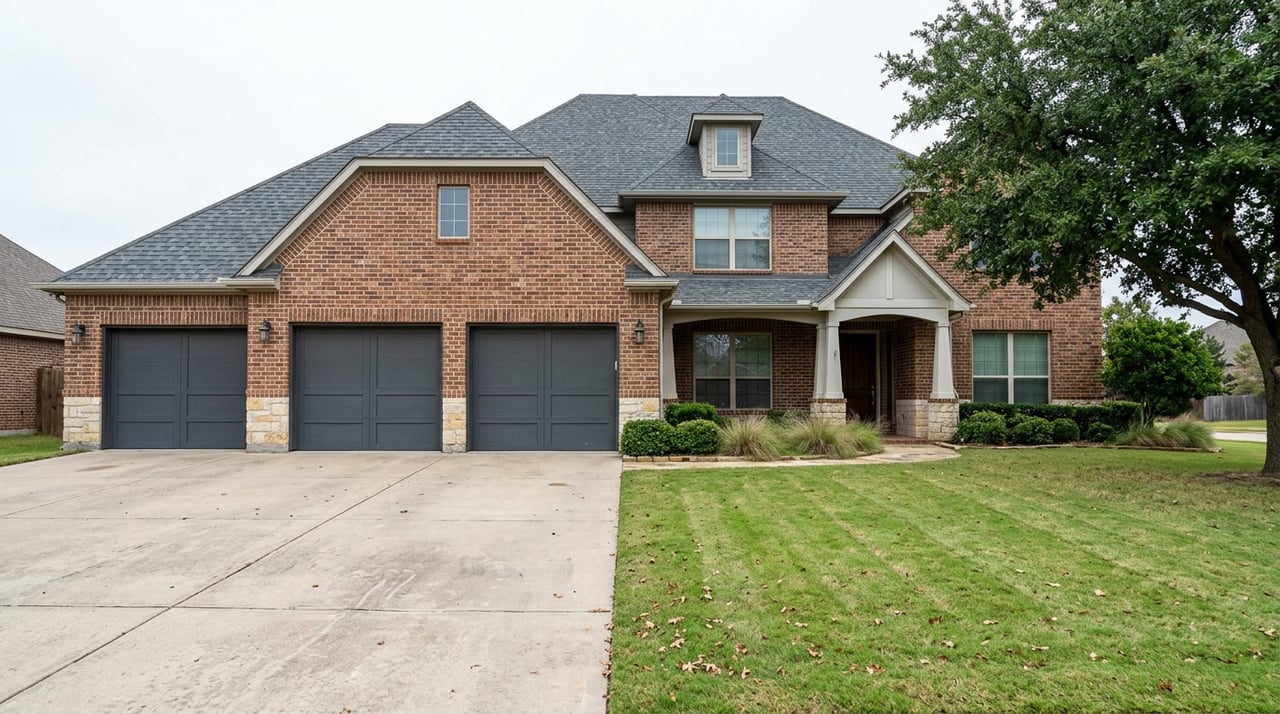
If you're comparing Moore against Norman or south Oklahoma City right now, here's a question worth sitting with before you get further into the search: when a listing says a house is "in Moore," which Moore does that actually mean?
There are at least three answers, and they don't line up. There's the city limit, the line that determines your water bill and your police department. There's the school boundary, which is a separate map entirely. And there's the tax structure, which just went through a public vote in April that didn't turn out the way city leadership expected. Buyers who treat "Moore" as one tidy unit end up surprised twice: once when they find out their address doesn't feed into the school they assumed, and again when they realize the property tax relief they may have heard about isn't actually coming on the timeline they were told.
Here's what's really going on, and why it matters more than the median price you've already seen on a portal.
The School Line Doesn't Follow the City Line
Moore Public Schools describes its own boundary plainly: within Cleveland County, the district includes the entire city of Moore, plus a large portion of southern Oklahoma City, and northern Norman. That's not a rounding error. It means the district's footprint stretches well past Moore's own city limits in one direction, while inside Moore there can still be pockets that feed into a different district depending on exact address.
A relocation-focused source covering the area puts it directly: Moore Public Schools serves parts of south Oklahoma City, so city limits and school boundaries do not always line up, and a Moore mailing address does not automatically tell you everything about school assignment. The district does offer open transfers and in-district transfers, which gives some families flexibility, but that flexibility is a workaround for a mismatch, not proof the mismatch doesn't exist.
The practical shape of the district: three high schools (Moore High School, Southmoore High School, and Westmoore High School), six junior highs, twenty-five elementary schools, and one alternative academy. If a specific school matters to your decision, the only way to know for certain is to check the individual address against the district's boundary tool, not the city name on the listing.
What Actually Happened on April 7, 2026
This is where the story gets more interesting than a boundary quirk, because Moore just ran a real experiment in how it funds itself, and the outcome changes what buyers should expect from their tax bill going forward.
For years, Moore has paid for capital projects, streets, sewer and drainage work, public facilities, through general obligation bonds, which are repaid through property taxes via the city's sinking fund. On April 7, 2026, the city put a different idea in front of voters: a one-cent increase to the sales tax, taking it from 8.5% to 9.5%, with the money split so that 90% would go to capital projects and 10% to public safety. City leadership, including City Manager Brooks Mitchell, framed the pitch around a specific trade: shift the funding source to sales tax, paid in part by people who shop in Moore but don't live there, and let the property tax portion of the bill decline as existing bonds get paid off instead of being replaced with new ones.
Voters said no. Local news coverage confirmed that Moore residents struck down the sales tax increase on the same day Norman voters approved five separate propositions of their own, including a street renewal project and a bond for a homeless shelter location. Moore's sales tax stays where it was, and so does its reliance on general obligation bonds backed by property tax.
Here's why that matters if you're comparing neighborhoods rather than just a number on a spreadsheet: the case for a falling property tax trajectory in Moore was built on a policy change that didn't happen. If you or your agent are working from year-old marketing material or a conversation that assumed the sales tax shift went through, the math needs to be redone.
What a Moore Tax Bill Is Actually Made Of
A Cleveland County tax statement for a home inside Moore's city limits and the Moore Schools district draws from four separate taxing entities: Cleveland County, Moore Schools, Moore-Norman Technology Center, and the City of Moore Sinking Fund. Each is expressed in mills, meaning dollars owed per $1,000 of assessed value, and each is set independently. The sinking fund piece is the one tied to city bonds and judgments, and it's the piece the failed April vote was aimed at shrinking over time.
Here's how Moore's current sales tax compares to its closest neighbors, using the per-dollar breakdown the city itself published ahead of the vote:
| City | Combined sales tax rate | Tax on a $10 purchase |
|---|---|---|
| Moore | 8.5% | 85 cents |
| Oklahoma City | 8.625% | 86 cents |
| Norman | 8.75% | 88 cents |
| Midwest City | 9.1% | 91 cents |
Moore currently sits at the low end of that range, which is part of why the city argued a one-cent increase wouldn't push it out of line with its neighbors. Voters weighed that argument against the certainty of a new tax and chose to keep things as they are, at least for now.
Why This Matters If You're Comparing, Not Just Pricing
A buyer scanning median prices across Moore, Norman, and south Oklahoma City is looking at a single number that hides two separate questions: which school will this address actually feed into, and which direction is the tax structure headed. Both questions require checking the specific parcel, not the neighborhood name.
For school assignment, that means using Moore Public Schools' own boundary tool for the exact address, not assuming based on the city name on the listing or the zip code.
For tax exposure, that means asking your title company or the Cleveland County Assessor's office for the current millage breakdown on a specific property, since the four line items on that bill move independently and the city's own plan to shrink the sinking fund portion didn't clear the ballot this spring. Verifying at the assessor level also tells you whether the property sits inside Moore's city limits at all, since parts of the school district extend into Oklahoma City and Norman where a different city government, and different city-level tax line, applies.
What to Confirm Before You Get Attached to an Address
- Pull the exact school boundary for the address, not the neighborhood, using the district's own boundary tool
- Ask whether open transfer or in-district transfer options are realistic for your situation if the assigned school isn't the one you want
- Request the current millage breakdown from the Cleveland County Assessor so you know what portion is county, schools, technology center, and city sinking fund
- Confirm whether the parcel is inside Moore's city limits or in the part of the school district that falls under Oklahoma City or Norman
- Don't assume a declining property tax trajectory based on the spring 2026 proposal. The April 2026 vote means the current funding model, and its current bond schedule, continues
None of this changes whether Moore is a good fit for a given household. It changes whether the decision is being made on accurate information instead of a marketing shorthand that treats an entire city as one number.
A Few Direct Questions
Does buying a home with a Moore address guarantee my kids attend a Moore school? Not automatically. Moore Public Schools' boundary extends into parts of south Oklahoma City and north Norman, and conversely, some addresses inside Moore's city limits may sit in a different district. Check the specific address against the district's boundary tool before assuming.
Is Moore's sales tax going up soon? Voters rejected the proposed increase from 8.5% to 9.5% in the April 7, 2026 election. Barring a new proposal and a new vote, the current rate stands.
Where do I check the actual property tax breakdown for a specific house? The Cleveland County Assessor's office maintains current assessment and millage information by parcel, which is the most reliable way to see the county, schools, technology center, and city sinking fund amounts for a specific address rather than a citywide average.
Moore rewards buyers who check the fine print instead of the flyer. If you're weighing a move into Moore, or trying to figure out how it stacks up against Norman, south Oklahoma City, or another Central Oklahoma suburb, the Kat Kosmala Group can walk through the specific boundaries and numbers for the address you're considering, not just the name of the city on the sign.


